Polyurethane Breast Implants: Pros and Cons
In this article, we will talk about breast implants that reduce the risk of the most common complication and the most common reason for revision breast surgery at least TEN times compared to other implants.
This information is scientifically proven and supported by the results of long-term clinical trials conducted by various doctors around the world. The Sources section provides links to studies confirming all the figures mentioned in the article.
What is capsular contracture?
The most common complication after breast surgery is capsular contracture - the formation of a dense fibrous capsule around the implant. It occurs as a reaction of the body to a foreign object.
This capsule forms in absolutely all patients after breast augmentation with implants. In most cases, it is thin - you don't see or feel it, and it does not cause any discomfort. But in some cases, a thick capsule forms, which starts to compress the endoprosthesis, making the breast firm and distorting its shape (this is capsular contracture of grades 3 and 4).
Unfortunately, this complication is the main reason for dissatisfaction with the result and the need for a repeat operation. According to FDA research results[1]: within 7 years after breast surgery, capsular contracture developed in 16% of patients with implants with smooth and textured surfaces. To correct this, a repeat operation with removal or replacement of the implants is required.
Polyurethane implants in combating contracture
It is impossible to completely eliminate the risk of capsular contracture, but it can be minimized by using implants with polyurethane coating.
Polyurethane breast implants are implants filled with cohesive silicone gel with a surface made of special medical polyurethane foam, absolutely safe for the body. Thanks to this coating, the risk of capsular contracture is reduced to 1% or less [4][5].
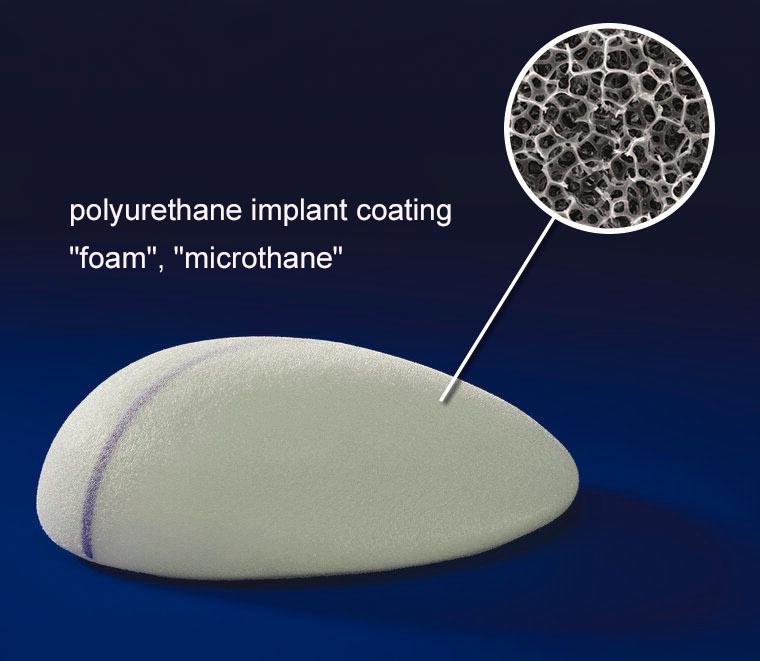
Photo: Breast implant with micro-polyurethane coating
Comprehensive long-term research[2] shows that after eight years in the body, the frequency of capsular fibrosis with implants with a micro-polyurethane shell is 15% lower than with textured implants and 30% lower than with implants with a smooth surface. Recent studies also indicate a reduced risk not only during primary augmentation but also in the case of two-stage reconstruction with an expander and implant, even after radiation therapy[3].
Are these new implants?
This type of implant is not new. They were first installed in 1968, so research data over more than 50 years shows that they are the safest on the market. Since 1970, more than 100 articles on the use of polyurethane implants have been published in scientific journals worldwide.

How does the 'foam' work: Velcro effect
When polyurethane implants are installed, the 'foam' becomes part of the capsule. It acts as a frame or grid to wrap around the collagen fibers that make up the capsule. They are stabilized and no longer align in a row, as in the capsules of smooth and textured implants. The fibers cannot slide against each other, so the likelihood of capsule compression is reduced.
The unique surface of polyurethane foam fixes the implant capsule like Velcro. Therefore, the implants remain in the place where they were positioned during the surgery. They do not slide, do not flip, and do not penetrate the tissues.
Which manufacturers of polyurethane implants are represented in Ukraine?
 There are only 2 manufacturers in the world that produce implants with a polyurethane shell - Polytech (Germany) and Silimed (Brazil). In the Ukrainian market, only implants from the company Polytech are present. I am pleased to work with products from this manufacturer because it is:
-
German quality
-
Wide range of implants (many options for projections, shapes, and sizes)
-
Silicone gel shell and implant are FDA approved
-
Implants have CE marking for use throughout Europe
-
The Polytech Polyurethane implants are covered by the Implants of Excellence Programme, which has been in operation for 25 years. The manufacturer provides a lifetime warranty for free implant replacement in case of rupture and for the development of capsular contracture (Baker grades 3 and 4) within 15 years for Microthane®
Advantages of polyurethane implants
The unique coating of polyurethane implants and their reliable fixation in tissues (especially important in the early stages) virtually eliminate complications after breast plastic surgery, such as:
- Synmastia - lack of intermammary space, monobreast due to implant displacement
- Double bubble "implant exit below the lower border" due to postoperative downward displacement
- Rotation (problem with teardrop-shaped implants - the risk of clockwise rotation or within the pocket).
Polyurethane implants have shown good statistics for other breast plastic surgery complications[4][5]:
- Hematoma - 1.2%
- Seroma - 2%
- Late seroma - 0%
- Implant rupture - 0.7%
- Rippling - 1.8%
Read also: Possible complications after breast augmentation. Should you be afraid of them?

Photo: Breast augmentation with Polytech Polyurethane implants
Disadvantages of polyurethane:
-
Micro-polyurethane implants require skillful surgical technique. They are more difficult to install. Many specialists simply do not undertake it because they do not know how to work with them. During surgery, the polyurethane implant is more difficult to align and position correctly; another pocket must be created for it. If the doctor makes a mistake with the position, it can only be corrected surgically in the first 7 days (then, for correction, the implant must be replaced with a new one at the clinic's expense). Any other implant can be adjusted with pressure tape (if it needs to be lowered) without surgery or surgically at any time, without replacing it with a new one. All of this makes the operation longer, more complicated, and more expensive for the clinic.
-
The cost of implants with a polyurethane coating is higher than regular ones
-
Difficulty in removing polyurethane implants. There are circumstances when implants need to be removed or replaced: complications, dissatisfaction with the aesthetic result, inappropriate size or shape of the implant, etc. Many patients are concerned about the question: will the micro-polyurethane shell, with its ability to grow into tissues, become a problem during forced implant removal? Yes, polyurethane implants are removed more difficultly than regular ones, but this is not a problem for an experienced surgeon and takes 10 minutes longer than removing a regular implant.
Read about Innovative lightweight B-lite implants with Microthane polyurethane coating
Conclusion
Breast implants made of polyurethane foam have proven their safety, have the lowest registered level of capsular contracture, and the frequency of repeat surgeries. They are the preferred choice of surgeons and patients in leading countries worldwide for breast implantation.
Sources:
-
FDA studies on NATRELLE® Silicone-Filled Breast Implants Smooth & BIOCELL® Texture
-
Aesthetic Surgery Journal, Volume 26, Issue 3, May 2006, Pages 265–274 Long-Term Safety and Efficacy of Polyurethane Foam-Covered Breast Implants
-
Aesthetic Surgery Journal, Volume 37, Issue 2, 1 February 2017, Pages 171–176 Polyurethane Implants in 2-Stage Breast Reconstruction: 9-Year Clinical Experience
-
Aesthetic Surgery Surgery 31:330-336, 2007 Polyurethane-Coated Silicone Gel Breast Implants Used for 18 Years
-
Aesthetic Plastic Surgery volume 36, pages331–338(2012) Back to the Future: A 15-Year Experience With Polyurethane Foam-Covered Breast Implants Using the Partial-Subfascial Technique
Author: Valentyn Zykov