Possible complications after mammoplasty. Should one fear them?
Any plastic surgery carries risks and breast augmentation surgery is no exception. According to world statistics, complications after mammoplasty are rare, on average in 5% of patients, however, unfortunately, no one is immune to this. Implants represent a foreign body for the organism and it is impossible to predict how it will react to their appearance.
At my preoperative consultations, as a doctor, I warn patients about possible complications, but at the same time I always focus on the fact that EVERYTHING is FIXABLE and no one will leave the patient in trouble. I absolutely require compliance with all necessary rules and restrictions after surgery to reduce the risk of complications (wearing compression underwear, a ban on sports for 2 months, taking medications, etc.)
Let's look what complications happen after breast augmentation with implants and how they can be resolved.
seroma hematoma keloid scars infection capsular contracture rupture of the implant implant displacement rippling double bubble
General surgical complications
Seroma
Seroma - accumulation of serous fluid between tissues and the implant. Seroma can manifest itself as a change of the shape of the breast, swelling of soft tissues, the appearance of pain, redness of the skin in the area of fluid accumulation, the release of serous matter over the edges of the wound. Seroma is bad because it stretches the pocket and the gland, while changing the shape and the size and causing asymmetry. And the implant can change its position in this overstretched pocket.

Causes of Occurrence: The main cause of seroma formation is an inflammatory process in the body and in the implant pocket area.
Most often, a seroma forms against the background of or after respiratory viral or bacterial illnesses: ARVI, flu, COVID, sinusitis, bronchitis, pneumonia, etc. Almost always, when body temperature rises for various reasons, a certain amount of serous fluid appears in the implant pockets. Therefore, it is very important to see a doctor in time.
Other possible causes include genetic pathologies, the body's reaction to the implant (sensitivity to biological material) or to suture material, problems with the patient's lymphatic system, damage to blood vessels during surgery, high blood pressure, as well as premature refusal to wear compression garments or intense physical activity during the postoperative period. In case of a seroma, wearing compression garments is very important to slow down the stretching of the implant pocket. A very important factor is the level of activity in the first weeks and months after surgery. Patients who become active right away, travel to resorts, sunbathe, or drink alcohol are more likely to develop seromas.
The main problem of seroma is that an additional volume of fluid stretches the pocket and increases the size of the breast, changes the shape and height of the breast. This leads to asymmetry. Moreover, this liquid can make it difficult to fix a polyurethane implant if it occurs in the first 3-6 weeks after surgery.
For the prevention of seroma is very important: to limit physical activity, wear compression underwear (especially when placing large sizes in already stretched tissues), take medications (including glucocorticosteroids) and undergo mandatory monitoring by your doctor. Initial seroma is easily amenable to drug treatment. And at the first signs of a change in shape, do not hesitate and come to your doctor for control.
Seroma can be diagnosed using ultrasound, X-ray mammography, magnetic resonance imaging.
According to world statistics: the probability of seroma in conventional textured implants is 5-10%, in polyurethane implants - 5%. Also, when placing an implant under the gland, the probability of seroma is a couple of percent greater than under the muscle.
Due to seroma, the implant may shift even with a polyurethane coating, as the liquid stretches the pocket and develops a place for the shift. This probability exists only in the first month after the installation of polyurethane implants. After a month, the tissues "grow" into the implant and then even seroma cannot move it.
How to resolve: There is a medical and surgical way to treat seroma. In case of a small accumulation of fluid, it will be enough to take antibiotics and anti-inflammatory drugs to resolve the problem. As the experience shows, when taking glucocorticosteroids for 10 days, any seroma goes away in a maximum of 2 weeks, but in most cases there is nothing on day 9.
The surgical method involves drainage, which takes place by installing a drainage tube through which lymph and other fluids are removed. In 95% of cases of seroma, compression underwear and medicinal treatment are sufficient, and only in 5% there is a need for a drainage.
Hematoma
Hematoma is the accumulation of blood in the pocket cavity around the breast implant.

Reason: injury of a blood vessel during surgery or in the postoperative period, high blood pressure, surgery during critical days.
How to resolve: the haematoma always resolves itself, additional methods are not effective.
Keloid scars
Formation of keloid scars is an excessive growth of connective tissue at the site of surgical incisions.

Reasons for development: features of the skin and tissue healing processes. A large visible scar can develop due to heavy long-term healing caused by improper care or suppuration. Sometimes this is a reaction to a dissolvable thread, then it is excised and re-sutured with another non-absorbable one.
How to resolve: The best method of dealing with scars is derma stamp. A derma stamp is multiple micro-injections that restart the healing process (by analogy with a tattoo). It was noticed that scars go away after tattoo, and are not just painted over.
Other methods of resolution: laser resurfacing, cryotherapy, surgical excision of scar tissue, the use of anti-scar drugs.
Inflammatory processes
Development of the infectious process - inflammatory processes in the body, which are characterized by pain which does not subside, and on the contrary increases, edema and redness of the skin increase, suppuration of wounds goes on. Inflammation can cause seroma, and seroma, in turn, causes capsular contracture.
Reason: The main reason is the excessive activity of the patient (sports, etc.), when the implant moves a lot inside of the pocket and literally rubs the surrounding tissues. Polyurethane does not have such a problem, since it is fixed to the chest. The second reason is a sustained acute respiratory viral infection (ARVI).
How to resolve: taking antibiotics, in severe cases - removal of the implant, followed by treatment and repeated mammoplasty after complete healing.
Specific complications (associated with the presence of an implant)
Capsular contracture
Capsular contracture is a complication when dense capsule of fibrous tissue forms around the implant, which leads to deformation of the shape of the implant and, accordingly, the shape of the breast.

Reason of occurrence: After implantation, the body creates a capsule of fibrous (scar) tissue around the implant in order to "isolate" itself from it. This is a natural reaction to any foreign object that is surgically implanted into the organism. Every patient who has breast implants will experience capsular contracture, but the degree may be different.
There are 4 degrees of capsular contracture according to Baker:
Grade 1: Breasts are soft and look natural
Grade 2: Breasts are a little hard but look normal
Grade 3: Breasts are hard and have deformity
Grade 4: Breasts are heavy, painful and have deformity
According to the world statistics: the probability of capsular contracture in conventional textured implants is 5%, in polyurethane implants - 0.04-1%
How to resolve: Grades 1 and 2 do not require intervention, and for grades 3 and 4, repeated surgery is required with excision of the capsule and replacement of implants with polyurethane ones. In the case of secondary mammoplasty due to capsular contracture, polyurethane-coated implants are ALWAYS installed!!! Such implants can minimize the risk of capsular contracture.
Rupture of the implant shell
If the implant is saline, then the breast will visually immediately become wrinkled. If there is a cohesive gel inside the implant (and now all advanced surgeons put only such implants), then the leakage is excluded, because the gel remains in place due to its viscous structure.
Reason: trauma, excessive pressure in the breast area, accidental damage to the implant during surgery, wear of the shell.
How to resolve: removal and replacement of the implant.
In modern heavy-duty implants filled with a cohesive gel, the probability of rupture is practically excluded
Implant displacement
Implant displacement is a deformation of the breast shape due to a change in the position of the implant to the wrong one.

Reasons: installation of the implant of a size larger than permissible, creation by the surgeon of a too large a pocket for the implant, due to capsular contracture, tension of the pectoral muscles (power sports), due to gravitation. Prostheses with a volume of more than 500 ml are more prone to displacement. Implants with a saline filler are heavier than silicone ones and are displaced more often. Implants located over the greater pectoral muscle are more likely to be displaced than those located under it.
According to world statistics: the probability of displacement or overturn in conventional textured implants is 5-10%, in polyurethane implants - 0% (possible only in combination with seroma when the implant floats in the serous fluid)
How to resolve: repeated surgery with replacement of implants
Rippling
Rippling, skin ripples (ironing board effect) - formation of small folds on the breast. It happens that visually these ripples are not visible, however, when one runs a hand over the breast, ripples can be sensed. They can be clearly observed when the body is tilted.

Reason: the use of saline or partially filled soft prostheses, insufficient volume and elasticity of the skin and soft tissues of the patient, incorrect selection of the implant and the site of installation.
According the to world statistics: the probability of rippling in conventional textured implants is 5-10%, in polyurethane implants - 0.01%
How to resolve: lipofilling (adding one's own adipose tissue for correction) or repeated surgery with replacement of implants.
Double bubble
Double bubble is a deformity of the breast in the form of a double fold. Visually, the breast and the implant do not look like a single whole, but rather like 2 bubbles located one on top of the other.

Reason: anatomical feature of the breast (when the main part of the glandular tissue is located in the upper pole of the breast, and the lower pole is reduced), tubular breast, incorrect placement of the implant, capsular contracture.
How to resolve: lipofilling; minimal surgical intervention (dissection of the skin of the mammary glands, careful straightening of internal tissues, formation of a new inframammary fold and suturing); repeated surgery with replacement of implants.
How to minimize the risks of complications after breast augmentation
We do everything possible to reduce the likelihood of complications and problems after breast augmentation: the operation is carried out in strict compliance with all the rules of sanitation while using innovative modern equipment, the shape and size of the implant is selected based on the patient's physical data (the volume of her own tissues, the width of the chest, etc.), implants of only proven world manufacturers are used.
A beautiful breast shape can be made with different implants, however, the safest and most trouble-free both for the doctor and the patient are polyurethane-coated implants. Polyurethane does not require compression underwear because it does not shift, one can sleep on the side and raise one's hands from the first day. At a touch, both texture and polyurethane are the same.
All this, combined with the patient's compliance with all recommendations during the rehabilitation period reduces the risks of complications to a minimum.
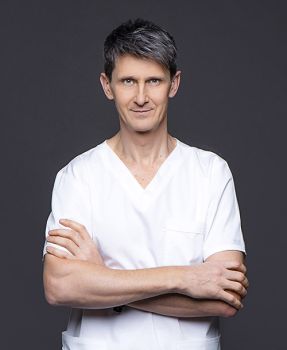
Content author - plastic surgeon Valentyn Zykov
- Practicing surgeon since 1998
- I perform more than 500 operations a year
- Laureate of the 21st national program "Person of the year"
- I operate in Poland (Warsaw) and Greece (Athens)