Write a comment
Face Lipofilling (filling with fat) is a procedure aimed at correcting the facial contour by transferring the patient's own fat tissue from one area to another using injections. Most commonly, areas such as the chin, cheeks, under-eye area, and temples are corrected.


Reconstruction of the mandible by fat and neck liposuction, after 2 hours
GO TO BEFORE AND AFTER GALLERY
Thanks to the procedure of lipofilling (or as it is also called, fat grafting), you can smooth out the contours of the face, eliminate asymmetry, and fill in "hollows" under the eyes. This operation helps to correct a number of aesthetic imperfections: drooping eyebrows, undefined jawline, "hollows," as well as enhance the cheek areas and chin.
When pinpoint plastic correction of a specific area of the face is needed, the lipofilling method is optimal.

Photo: Temporal facelift and facial lipofilling - before and after
Indications
Over age, atrophic changes take place in soft tissues. This is a reason of wrinkles and folds; the face has a tired and exhausted look. In such cases, injections of the own fatty tissue give a wonderful opportunity to restore lost volumes and do more.
Lipofilling helps removing a huge number of cosmetic and esthetic deficiencies:

- Removal of nasolabial folds
- Removal of lacrimal grooves
- Correction of shape of chin and cheekbone areas
- Modeling of contour and size of lips
- Correction of facial oval
- Esthetic correction of age-related changes of hands and face
- Correction of retracted scars
- Leveling of corrugations after liposuction
- Augmentation of breast and buttocks
- Improvement of contours of shanks and hips, correction of curvature of legs.
Procedure Process
Procedure Duration: Up to 1 hour
Anesthesia: General (gas or intravenous)
Lipofilling involves the extraction of excess fat tissue from the patient's body and reimplantation into areas where fat is deficient. This process can be broken down into 3 stages:
-
Fat Harvesting: A certain amount of adipose tissue is harvested from various areas with sufficient subcutaneous fat, such as the thighs or abdomen, using a specialized syringe. The needle of such a syringe (cannula) has a rounded tip, so there is no damage to nerves and large blood vessels.
-
Processing of Fat Tissue: At this stage, the harvested substance undergoes processing — it is purified from blood fraction and anesthetics, which provide anesthesia.
-
Injection of Purified Fat: The most time-consuming part of the procedure involves the gradual injection of the purified fat tissue in thin layers into areas of the face or body requiring correction (subcutaneous, intramuscular spaces). Then, stitches are applied to the incisions made in the skin, after which the lipofilling procedure can be considered complete.

Photo: Chin, jawline, and rhinoplasty lipofilling - Before and After
In lipofilling, foreign fat is not used due to the enormous risk of rejection and possible complications. Only the patient's own, properly prepared fat is reimplanted.
Advantages of Lipofilling:
-
Adipose (fat) tissue is a rich source of stem cells, surpassing other tissues in the body in their quantity. Therefore, in addition to correcting deficient volumes, lipofilling can lead to significant improvement in tissue quality: skin texture and color become smoother, scars diminish. Another advantage of this method is the improvement not only in the injected fat area but also in the area from which it was harvested.
-
Lipofilling has a greater safety advantage over contour plastic surgery. Additionally, there is no need for regular fat addition.
Rehabilitation
Immediately after the surgical intervention, the patient is taken to a ward for observation and stays in the hospital under medical supervision for 1 day. As the anesthesia wears off, discomfort and pain in the area of fat harvesting and injection may occur. This is a normal process, and the discomfort and pain gradually subside.

Postoperative swelling and bruising — resolve within 2 weeks. The severity depends on the volume and area of the procedures performed. Camouflaging cosmetics and wearing sunglasses can be used.
Postoperative stitches and injection sites require care until fully healed.
Sports and physical activity. It is prohibited to engage in sports and overexert oneself for 4 weeks after the operation.
Follow-up appointments. Scheduled between 5 and 10 days after the operation
One week after the lipofilling procedure, when tissue swelling subsides completely, noticeable effects can be observed. Complete recovery of transplanted tissues occurs within 2 months, as the injected fat layer is vascularized and begins to receive the necessary nutrients.
Postoperative swelling and bruising — resolve within 2 weeks. The severity depends on the volume and area of the procedures performed. Camouflaging cosmetics and wearing sunglasses can be used.
Postoperative stitches and injection sites require care until fully healed.
Sports and physical activity. It is prohibited to engage in sports and overexert oneself for 4 weeks after the operation.
Follow-up appointments. Scheduled between 5 and 10 days after the operation
One week after the lipofilling procedure, when tissue swelling subsides completely, noticeable effects can be observed. Complete recovery of transplanted tissues occurs within 2 months, as the injected fat layer is vascularized and begins to receive the necessary nutrients.
Lipofilling is a low-risk and minimally invasive procedure, but it is contraindicated in patients with diabetes and impaired blood supply, as fat cells die during transplantation in such conditions.
What percentage of fat survives after transplantation?
Even 10 years ago, there were active debates at plastic surgery conferences regarding the percentage of fat survival: one group of surgeons claimed that only 10-20% survives, another - about 50%, and a third - up to 70%. Each of them was actually correct. The problem was that the technique of fat harvesting and injection varied among doctors.
Lipofilling may seem like a relatively simple plastic surgery procedure at first glance, but the fat transplantation process has NUMEROUS NUANCES that subsequently affect the percentage of surviving fat:
Incorrect fat harvesting. If too much solution is injected during liposuction (making fat harvesting easier and less bloody), the percentage of fat cells per milliliter of injected component will be much lower, resulting in poorer survival rates.
Use of centrifuge after fat harvesting. Currently, the use of a centrifuge is not recommended, as it separates fat cells (adipocytes) from stem cells, which end up at the bottom along with the solution and then are drained, leading to lower survival rates.
After fat harvesting, it is crucial to mix it! Failure to do so causes fat to fractionate rapidly, literally within 2 minutes it becomes fragmented: oil on top, fat cells in the middle, and blood at the bottom. For example, if a nurse who hands a ready-filled syringe to the doctor draws one portion from the bottom, where there will be blood, and the second portion from the middle, where there are many fat cells, then naturally the result after the injection of the first portion will be almost imperceptible.
Bolus injection. If fat is injected with a thick cannula, bolus-like, a large ball is formed, and naturally, there will be a high percentage of fat cells that simply do not come into contact with living tissue and therefore cannot survive. Fat should be injected in microportions, and with a thin cannula, which is a very painstaking process. The thin millimeter cannula creates microchannels, and with each pass, we introduce no more than 1/20 of one cubic centimeter. Imagine the difference between 1/20 of a cubic centimeter and immediately 10 cubic centimeters with bolus injection. Doctors often resort to bolus injection, performing several operations at once in one swipe (for example, rhinoplasty + liposculpture) to save time.

Final Result
The transplanted fat is present already within a month after lipofilling. However, there are some fat cells that have not yet survived as well. The entire exchange process, both the survival and utilization of broken-down fat, is completed by 6 months, and then we can see the final result. As for facial lipofilling, the result can be seen even earlier because there is good blood supply and small injection volumes, while lipofilling of the buttocks - not earlier than 6 months.
From my practice, on average, about 50% of the fat survives, so during lipofilling, it is necessary to intentionally inject an excess of fat, more than necessary, considering that the fat volume will decrease.
In support of the effectiveness of lipofilling, I can say that in Brazil and Colombia, it is the number one operation. Patients (often still young, so there is no skin sagging) have fat removed from the waist in a circle and injected into the buttocks, on average about 1-1.5 liters into each. And after 2-3-4 years, no one says that the buttocks have significantly reduced. If the fat did not survive so well, this technique would have been abandoned long ago. However, there are also dissatisfied patients, to whom the fat was either injected poorly or, on the contrary, there was an excess (when it was injected in good quality and a lot). These are the two main problems of lipofilling.
I have listed far from all the technical nuances of lipofilling. All these details greatly affect the final result. Unfortunately, not all doctors adhere to the technology correctly, resulting in different results even with the same injected volumes. Hence the stories of dissatisfied patients about fat non-survival, lumpiness, etc. Lipofilling nowadays is one of the most demanded operations, both as an independent procedure and as an addition. All top plastic surgeons in the world have long been using this technique.
Other Areas for Lipofilling
This is a procedure for correcting the shape of the breast using the patient's own fatty tissue. Breast lipofilling is the most effective way to restore the breast after the removal of a cancerous tumor, as it avoids foreign artificial materials. With the help of lipofilling, it is possible to effectively restore the shape of the breast after an intensive weight loss course, correct obvious breast asymmetry, and give a more beautiful shape.
The essence of this operation is to inject purified fatty tissues into tiny incisions prepared in the folds under and between the buttocks. Fatty tissues are taken from the hips, abdomen, sides, as well as the lower part of the back and injected in a strictly calculated amount.
Thus, the correct shape of the buttocks is created according to a pre-prepared sketch. The duration of this procedure takes no more than an hour.
This is a procedure that helps rejuvenate the hands. Hands often reveal one's age, despite a youthful face and a beautiful neck. Veins, tendons, and other anatomical parts of the hands become more noticeable due to the subcutaneous fat tissue, which decreases with age.
Creams and other cosmetic products maintain the appearance of the skin, but cannot affect the subcutaneous fat layer. Therefore, fat filling is an excellent and effective method of combating age-related changes in the hands.
Frequently Asked Questions About Lipofilling
Is there a risk that the fat won't survive?
Can you transplant fat from another patient, for example, a relative, to yourself?
How does transplanted fat behave over time? Does it migrate?
In which areas does fat grafting have better survival rates?
Can you enhance lips with fat, like with lipofilling?
What's better for correcting the nasolabial fold: fat or fillers?
What's better for chin augmentation: fat or implants?
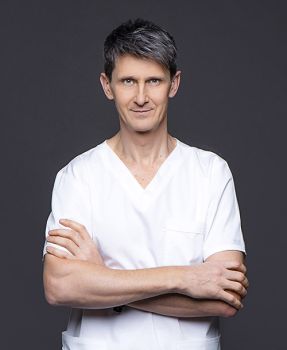
Content author - plastic surgeon Valentyn Zykov
- Practicing surgeon since 1998
- I perform more than 500 operations a year
- Laureate of the 21st national program "Person of the year"
- I operate in Poland (Warsaw) and Greece (Athens)